
To shield against US President Donald Trump's tariff shock, analysts have been advising investors to focus on stocks of domestic-oriented companies, rather than export-centric ones, to minimise potential losses.

'Oil is still well below its all-time highs, and the world is gradually running out of known reserves.'

Most first-time investors may be better served by diversified options such as flexicap or multi-cap funds, which already hold pharma and healthcare stocks.

'Right now, silver -- and especially platinum -- are very cheap compared to gold. If I were buying today, I would choose platinum.'

Circuit Breaker is a system to sustain sanity of the stock market
It will be difficult for the Indian equity to outperform overall growth to the extent bullish observers expect.

Most experts said indices would open higher on Monday and rally might sustain for a few sessions

Titan surged 2.98 per cent, followed by IndusInd Bank, ITC, JSW Steel, Infosys, Tech Mahindra, Tata Consultancy Services and Maruti. Hindustan Unilever, Asian Paints, Bharti Airtel and HDFC Bank were among the laggards.

Among Sensex firms, Trent, ICICI Bank, Tech Mahindra, Bajaj Finserv, Mahindra & Mahindra, Power Grid, Tata Consultancy Services and Bajaj Finance were the major laggards. However, Tata Steel, Larsen & Toubro, State Bank of India, Kotak Mahindra Bank were among the major gainers.

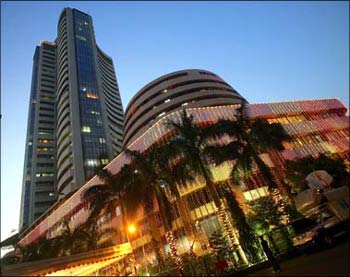
BSE is among the world's ten largest exchanges in terms of market value

'I expect IT stocks to trade lower for some time. They are unlikely to make money for investors.'

Indian economy is doing well and the performance of domestic stock markets is not as bad as that of other nations.

Investors' wealth eroded by Rs 9.51 lakh crore on Monday morning, following a crash in equity markets where the benchmark Sensex tanked over 2,400 points, mirroring a sharp plunge in global peers. The 30-share BSE benchmark tanked 2,401.49 points to 78,580.46 in early trade. Following the sharp decline in equities, the market capitalisation of BSE-listed firms dropped by Rs 9,51,771.37 crore to Rs 4,47,65,174.76 crore ($5.35 trillion) during the morning trade.

The divergence shows lack of financial depth in the Indian stock markets.

The Securities and Exchange Board of India (Sebi) on Thursday debarred Ketan Parekh, the stock market operator involved in the stock market scam of 2000, Singapore-based trader Rohit Salgaocar, and one other individual from the securities market for alleged front-running of trades of a United States (US)-based foreign portfolio investor (FPI). The FPI manages around $2.5 trillion worth of funds globally.

Global markets trends, inflation, release of industrial output data and quarterly earnings will dictate movement of the equity benchmarks this week, analysts said, adding that volatility might continue amid slew of announcements of macroeconomic data at the global level too. Moreover, foreign fund movement, crude oil prices and trend in rupee would also act as major drivers for the equity market, they added. "The direction of global equity markets along with movement in dollar index and crude oil prices will continue to dominate while inflation numbers of the USA on May 11 and inflation and IIP numbers of India on May 12 will also cause volatility in the market," said Santosh Meena, head of research, Swastika Investmart Ltd.

A Jefferies report warns that the IT services sector is set for a structural shift due to AI, requiring talent and operating model overhauls and increasing cyclicality.

Infosys shares experienced a significant drop, hitting a 52-week low, after the company announced its Q4FY26 results and provided a modest revenue growth guidance of 1.5-3.5 per cent in constant currency for FY27, falling below market expectations and raising concerns about AI-led deflation and margin pressures.

Among Sensex firms, Kotak Mahindra Bank, Larsen & Toubro, Mahindra & Mahindra, Maruti, Bharti Airtel and Tata Steel were the major gainers. However, Asian Paints and Bajaj Finance were the laggards.

Macroeconomic data, the pace of vaccination and global trends would be the major drivers for the domestic equity markets this week, analysts said. Besides, the progress of monsoon will also be monitored. "This week marks the beginning of the new month also, so participants will be eyeing the high-frequency indicators like auto sales and manufacturing PMI during the week. "Besides, the progress of monsoon will also remain on their radar.

The 30-share BSE benchmark tanked 535.57 points or 1.13 per cent to close at 46,874.36 on Thursday. It has now lost 2,917.76 points in five days.

The US Fed interest rate decision, inflation data and FIIs are the key factors that are expected to drive stock markets this week, analysts said. Global trends will also be tracked by investors for further cues, they added. "The Indian stock market's future trajectory will be influenced by a blend of global and domestic factors.

Foreign portfolio investors (FPIs) infused Rs 22,615 crore into Indian equities in February, marking the highest monthly inflow in 17 months, driven by factors such as the interim India-US trade deal, correction in domestic market valuations, and strong corporate earnings.

Concerns over weakening demand for Indian pharmaceutical (pharma) drugs in the US - their largest export market - have weighed heavily on investor sentiment this year. While the Nifty 50 has gained 6.02 per cent year - to - date (as on September 15), the Nifty Pharma index has declined 5.18 per cent, National Stock Exchange data shows.

Axis Bank, HCL Technologies, Maruti Suzuki, NBCC and Union Bank are their top five stock picks.
India VIX has been mirroring the CBOE Volatility Index.
We are at the cusp of something big today and retail investors need to wake up and participate early to make the most of it.

Domestic equities surged on Tuesday, posting their best single-day gains in more than eight months after a long-awaited trade deal between India and the US. The deal, which lowered tariffs on Indian goods to 18 per cent from 50 per cent, significantly improved investor sentiment and lifted a key overhang for the market.

Dalal Street investors were a poorer lot on Monday as their wealth eroded sharply by Rs 14 lakh crore following a sharp decline in benchmark indices amid a global market meltdown due to recession fears. The 30-share BSE Sensex tumbled 2,226.79 points or 2.95 per cent to settle at 73,137.90. Intra-day, the benchmark slumped 3,939.68 points or 5.22 per cent to 71,425.01.

Benchmark stock indices Sensex and Nifty closed higher on Thursday, helped by a rally in blue-chip Larsen & Toubro and the Economic Survey projecting the GDP growth of 6.8-7.2 per cent for the next fiscal.

Domestic benchmark equity indices may see a positive trading sentiment on Friday thanks to a spectacular rally in world markets after the US President Donald Trump announced to put tariff hikes on hold for 90 days, excluding China from the reprieve. Indian stock markets were closed on Thursday for Shri Mahavir Jayanti. Trump has declared a three-month pause on reciprocal tariffs on non-retaliating countries marking a rather unexpected U-turn after record high levies he imposed led to global stock market meltdown.

Stock market investors became richer by a whopping Rs 77.66 lakh crore in 2024, helped by an overall optimistic trend in equities, where the BSE Sensex surged over 8 per cent. Analysts said the year witnessed a tug of war between the bulls and bears marked by volatility but, despite the uncertainties around the world, the Indian markets sustained the pressure and delivered impressive returns.

Exchange Traded Funds (ETFs) have stepped into the spotlight this quarter. With evolving market conditions and shifting investor sentiment, ETFs offer a timely solution for accessing growth with liquidity and efficiency. In this article, we break down the most important ETF trends, performance drivers, and what to watch in the months ahead.

From the Sensex firms, Bharat Electronics, Bajaj Finance, Bajaj Finserv, Axis Bank, Maruti and Tata Motors were among the gainers. However, Eternal, Hindustan Unilever, Trent and Titan were the major laggards.

For the first time in the history of the stock market, investors who lost out on allotment of shares due to a scam will receive compensation from money recovered from scamsters.

Eighteen new-age technology firms went public during the year, a near triple increase from the five firms that debuted in 2023 and 38 per cent more than 2024's tally of 13.

Margin Trading Facility (MTF) provides an avenue for traders to magnify their potential returns by trading with borrowed money; however, it carries inherent risks. While the lure of increased purchasing power is strong, responsible engagement with MTF requires having a clear understanding of the MTF feature. In this blog, we will explore the key do's and don'ts of those who are considering using MTF.

New-age stocks to buy: Most new-age stocks have turned out to be wealth destroyers in stock markets, so far, in calendar year 2025. Shares of Ola Electric Mobility, for instance, have plunged nearly 50 per cent in the first half of CY 2025, while those of Swiggy, PB Fintech, Paytm, and Eternal (Zomato) have crashed between 6 per cent and 25 per cent, ACE Equity data shows.

NTPC, Power Grid, Kotak Mahindra Bank, Maruti, Tech Mahindra, Larsen & Toubro, Reliance Industries and Adani Ports were the other big gainers. Mahindra & Mahindra, Bajaj Finserv, Bajaj Finance, Axis Bank and Tata Motors were among the laggards.

Many are attracted by the potential for large gains, but don't necessarily seem to understand that a single trade gone wrong can wipe out their accumulated profits.
